
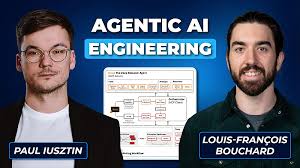
Paul Iusztin – Agentic AI Engineering
$449.00 Original price was: $449.00.$45.00Current price is: $45.00.
- 24/7 Contact Support & Telegram - Ecomkevin_1
- You Can Request Any Courses
- Original Courses HD Qualite and links updated
Guaranteed Safe Checkout


Description
Paul Iusztin – Agentic AI Engineering
Artificial intelligence is no longer limited to static models that generate text or predictions. The new frontier is agentic systems—AI entities capable of reasoning, planning, executing tasks, and continuously improving through interaction. At the center of this movement stands Paul Iusztin – Agentic AI Engineering, a concept that represents both a technical philosophy and a practical roadmap for building autonomous AI systems that operate independently and intelligently.
This comprehensive guide explores the foundations, methodologies, tools, architecture patterns, and future implications of agentic AI systems inspired by the principles behind Paul Iusztin – Agentic AI Engineering. Whether you are a developer, founder, AI enthusiast, or technical strategist, this deep-dive will equip you with clarity and actionable direction.
What Is Agentic AI Engineering?
Agentic AI Engineering is the structured approach to designing AI systems that behave as autonomous agents. Unlike traditional AI models that respond passively to prompts, agentic systems:
-
Set goals
-
Break goals into tasks
-
Execute actions
-
Analyze feedback
-
Adapt strategies
-
Iterate continuously
In essence, agentic AI systems simulate decision-making patterns similar to human operators but at machine scale and speed.
The methodology behind Paul Iusztin – Agentic AI Engineering focuses on bridging research concepts with production-ready engineering practices. It emphasizes reliability, orchestration, memory systems, tool integration, and scalable architecture.
The Core Principles Behind Agentic Systems
To understand the depth of Paul Iusztin – Agentic AI Engineering, we must examine its foundational pillars.
1. Goal-Oriented Autonomy
An agent must be capable of receiving high-level goals instead of low-level instructions. For example:
-
Traditional AI: “Summarize this document.”
-
Agentic AI: “Analyze the company’s financial health and provide improvement recommendations.”
The agent determines subtasks independently:
-
Extract financial metrics
-
Compare industry benchmarks
-
Identify weaknesses
-
Propose optimizations
2. Planning and Decomposition
True autonomy requires structured reasoning. Agents:
-
Break objectives into micro-tasks
-
Prioritize tasks
-
Evaluate dependencies
-
Optimize execution order
Planning algorithms and chain-of-thought reasoning form the backbone of intelligent execution.
3. Tool Usage
Modern agentic systems extend beyond text generation. They integrate with:
-
APIs
-
Databases
-
Code execution environments
-
Browsers
-
File systems
-
CRM platforms
A well-designed agent does not “guess”—it verifies information through tools. This tool-augmented reasoning is a core theme in Paul Iusztin – Agentic AI Engineering.
4. Memory Systems
Agents require:
-
Short-term working memory
-
Long-term persistent memory
-
Context-aware retrieval systems
Vector databases and structured storage solutions allow agents to recall past actions, learn from previous outcomes, and maintain coherence over time.
5. Feedback Loops
Continuous self-evaluation differentiates powerful agents from simple automation scripts. Feedback loops allow:
-
Error detection
-
Strategy refinement
-
Performance scoring
-
Adaptive decision-making
Architecture of an Agentic AI System
The engineering approach promoted by Paul Iusztin – Agentic AI Engineering emphasizes modular and scalable design. A typical architecture includes:
1. Orchestrator Layer
This layer coordinates:
-
Task planning
-
Sub-agent communication
-
Tool routing
-
State tracking
It acts as the “brain manager” of the entire system.
2. Reasoning Engine
Powered by large language models, this component:
-
Interprets goals
-
Generates plans
-
Evaluates alternatives
-
Decides next actions
3. Tool Interface Layer
APIs and execution modules enable the agent to:
-
Fetch real-time data
-
Execute code
-
Send emails
-
Interact with external platforms
4. Memory Module
Includes:
-
Vector embeddings
-
Structured databases
-
Session state storage
5. Monitoring & Evaluation
Production-level agentic systems require:
-
Logging
-
Observability tools
-
Error tracking
-
Performance analytics
Without monitoring, autonomy becomes chaos.
Real-World Applications
Agentic AI is not theoretical. It is actively transforming industries.
Autonomous Research Assistants
Agents can:
-
Conduct literature reviews
-
Extract insights from multiple papers
-
Compare methodologies
-
Summarize trends
AI Business Operators
Companies use agentic systems to:
-
Manage marketing campaigns
-
Optimize ad performance
-
Track customer interactions
-
Generate reports
Development Agents
Software engineering agents can:
-
Write code
-
Debug applications
-
Run tests
-
Deploy updates
The engineering practices inspired by Paul Iusztin – Agentic AI Engineering focus on making such systems stable and reliable in production environments.
Agentic AI vs Traditional Automation
Understanding the distinction clarifies the value proposition.
| Traditional Automation | Agentic AI |
|---|---|
| Rule-based | Goal-based |
| Static workflows | Dynamic planning |
| Limited adaptability | Continuous improvement |
| No reasoning | Contextual reasoning |
Traditional automation executes predefined instructions. Agentic systems decide how to accomplish goals dynamically.
Building Agentic Systems: Step-by-Step Framework
Here is a structured roadmap aligned with Paul Iusztin – Agentic AI Engineering principles:
Step 1: Define Clear Objectives
Start with:
-
Measurable outcomes
-
Constraints
-
Required tools
-
Success metrics
Step 2: Design Task Decomposition Strategy
Implement planning modules capable of:
-
Breaking goals into atomic actions
-
Validating task logic
-
Avoiding redundancy
Step 3: Integrate Tools
Connect APIs and services that allow real-world execution.
Step 4: Implement Memory
Choose appropriate storage:
-
Vector database for semantic retrieval
-
SQL for structured tracking
-
Hybrid approaches
Step 5: Add Evaluation Loops
Agents must:
-
Reflect on results
-
Identify failures
-
Retry intelligently
Step 6: Deploy with Observability
Use logging systems and monitoring dashboards to track agent performance.
Challenges in Agentic AI Engineering
While promising, the field faces technical and ethical challenges.
1. Hallucinations
LLMs may fabricate data. Tool-based verification reduces risk.
2. Infinite Loops
Without constraints, agents may re-execute tasks unnecessarily.
3. Security Risks
Agents interacting with APIs must have:
-
Role-based access control
-
Sandboxed environments
-
Rate limiting
4. Cost Management
Agentic systems can be expensive due to multiple API calls. Optimization strategies include:
-
Prompt compression
-
Efficient retrieval
-
Task batching
Why Agentic AI Is the Future
The world is moving toward AI systems that do not simply assist but act.
Agentic systems enable:
-
Automated startups
-
AI-powered digital employees
-
Continuous data monitoring
-
Personalized decision engines
The strategic vision embodied in Paul Iusztin – Agentic AI Engineering is about building AI that becomes a collaborator rather than a passive tool.
Advanced Concepts in Agentic AI
For experts looking deeper:
Multi-Agent Systems
Multiple agents collaborate:
-
Research agent
-
Execution agent
-
Evaluation agent
-
Memory curator
This layered approach improves robustness.
Hierarchical Planning
Higher-level agents delegate to specialized sub-agents.
Self-Improvement Mechanisms
Agents can analyze performance logs and optimize prompts autonomously.
Production-Ready Best Practices
-
Start small and iterate.
-
Limit tool access.
-
Enforce execution constraints.
-
Add timeout thresholds.
-
Monitor behavior continuously.
-
Conduct red-team testing.
-
Optimize prompts systematically.
Engineering discipline transforms experimental agents into reliable digital operators.
The Strategic Advantage
Organizations adopting agentic systems early gain:
-
Operational speed
-
Lower labor costs
-
24/7 automation
-
Scalable intelligence
By internalizing the philosophy of Paul Iusztin – Agentic AI Engineering, companies position themselves ahead of competitors relying solely on static AI tools.
The Road Ahead
The next evolution includes:
-
Autonomous financial agents
-
AI-driven legal assistants
-
Personalized education agents
-
Cross-platform digital executives
As model capabilities improve, agentic frameworks will become foundational infrastructure across industries.
The shift from prompt engineering to agent engineering marks a defining transformation in artificial intelligence. It is no longer about crafting better prompts—it is about designing intelligent systems that think, act, evaluate, and evolve.
Conclusion
Agentic AI Engineering represents the transition from reactive AI to proactive intelligence. By focusing on autonomy, planning, memory, tool integration, and feedback loops, engineers can build systems capable of operating independently in complex environments.
The philosophy behind Paul Iusztin – Agentic AI Engineering emphasizes structured development, production reliability, and scalable design. It bridges theoretical AI research with real-world deployment strategies.
As industries demand smarter automation, agentic systems will redefine workflows, digital infrastructure, and human-machine collaboration. The engineers who master these principles today will lead the next decade of artificial intelligence innovation.
Reviews
There are no reviews yet.