
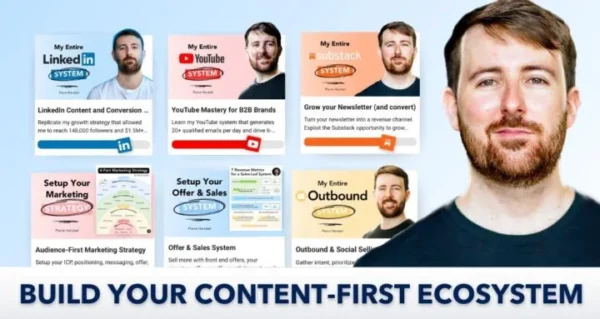
Pierre Herubel – Content-First Ecosystem
$97.00 Original price was: $97.00.$29.00Current price is: $29.00.
- 24/7 Contact Support & Telegram - Ecomkevin_1
- You Can Request Any Courses
- Original Courses HD Qualite and links updated
Guaranteed Safe Checkout


Description
Introduction
In the fast-evolving digital landscape, brands and creators alike are realizing that content isn’t just a supporting tool — it’s the nucleus of sustainable growth. That’s where Pierre Herubel — Content-First Ecosystem comes in: a holistic framework designed to place storytelling, audience value, and systematic content creation at the core of your marketing strategy. In this article, we’ll dive deeply into how the content-first ecosystem works, what its pillars are, and how you can apply it to outpace competitors.
Why a Content-First Ecosystem Matters
Traditional marketing often treats content as an afterthought — a blog post, email, or social media update tacked on to a campaign. But that approach misses the point. A content-first ecosystem inverts the hierarchy: content becomes the product, the funnel, and the brand voice, all at once.
By designing your marketing infrastructure around content, you:
-
Build deeper relationships: Quality storytelling fosters trust and loyalty.
-
Drive scalable organic reach: Content compounds over time, bringing inbound traffic.
-
Create flexibility: You can repurpose content across channels.
-
Withstand platform changes: Algorithms shift, but strong content retains value.
Pierre Herubel’s approach reframes content not as collateral, but as the core operating system for growth.
Core Pillars of a Content-First Framework
To operationalize this ecosystem, you’ll need to build around several foundational pillars. Let’s explore each one in detail.
1. Audience Architecture & Persona Mapping
At the heart lies a deep understanding of your audience. You must go beyond surface demographics and understand:
-
Aspirations: What goals, dreams, or transformations do they seek?
-
Pain points: What obstacles keep them up at night?
-
Content consumption habits: Which channels, formats, and frequencies do they prefer?
-
Language & voice: What words, tone, and style resonate?
By mapping personas and audience architectures, every piece of content you produce becomes strategic rather than random. In a content-first ecosystem, persona clarity guides everything — from topic selection to distribution methods.
2. Core Content Engine (Content Pillars & Clusters)
Once audience insights are in place, build your content engine. This means:
-
Defining 3–5 core pillars or themes that align with your niche and audience dreams
-
Developing content clusters or topic trees around each pillar
-
Establishing a consistent publishing cadence
-
Ensuring each piece links contextually to others (internal linking, thematic coherence)
This method turns your content into a self-reinforcing web. One strong “pillar article” becomes a hub, and cluster posts feed into it, boosting SEO and reader retention.
3. Storytelling & Narrative Design
Data and tactical frameworks are important, but stories win hearts. In the ecosystem championed by Pierre Herubel, narrative design is essential:
-
Craft your origin story and brand mythology
-
Use character arcs (you, your customer, your transformation journey)
-
Embed frameworks — problem → solution → result
-
Apply emotional storytelling, weaving logic with pathos
Your content becomes more than information — it becomes engaging, memorable, and shareable.
4. Content Lifecycle & Repurposing Strategy
Creating content isn’t enough — you must amplify it through a lifecycle:
-
Launch: Publish and initially promote (email, social, paid)
-
Evergreen updates: Refresh content, update data, expand appendices
-
Repurpose: Turn blogs into videos, podcasts, infographics, carousels
-
Syndication: Share on Medium, LinkedIn, guest blogs, newsletters
-
Distribution loops: Use email sequences, social drip campaigns, ads
A content-first ecosystem derives exponential leverage as you reuse and reformat your cornerstone assets across touchpoints.
5. Demand Capture & Conversion Funnels
In this system, content plays a lead role in funneling people toward desired actions:
-
Use content upgrades (PDFs, checklists, mini-courses) embedded in blog posts
-
Gate deeper content behind lead magnets
-
Use educational email sequences tied to content pillars
-
Route to low-friction offers, tripwires, or consultations
-
Use stories, case studies, and proof within content to convert
Rather than pushing hard sales messages, you create natural pathways from helpful content to conversions.
6. Analytics, Feedback Loops & Optimization
No ecosystem survives without measurement. You need to establish real-time feedback loops:
-
Track content engagement: time on page, scroll depth, shares
-
Monitor traffic sources and SEO performance
-
Follow your funnel metrics: conversions per piece, opt-in rates
-
Solicit feedback: polls, surveys, comments
-
Iterate: prune underperforming content, boost winners, test headlines, formats, angles
This loop ensures your ecosystem evolves and beats competitors over time.
7. Team & Workflow Infrastructure
To scale, you need structure:
-
Roles: content strategists, writers, editors, designers, amplifiers
-
Processes: briefs, reviews, style guides, content calendars
-
Tools: editorial tools, SEO tools, analytics dashboards, automation
-
Governance: version control, updates schedule, quality assurance
Pierre Herubel emphasizes that scaling a content-first ecosystem isn’t ad hoc — it’s a system you run like a media company.
Implementation Roadmap (Step-by-Step)
Here’s a sequential roadmap to build your own ecosystem:
-
Audience Deep Dive
Conduct interviews, surveys, analyze competitors, and build personas. -
Define Pillars & Theme Clusters
Identify your core topics and create a content map showing pillar articles and subtopics. -
Write Your First Pillar Content
Produce a definitive, long-form evergreen piece that will anchor your ecosystem. -
Create Cluster Content
Write supporting posts that link into the pillar and to each other, covering related angles. -
Design Your Story Threads
Define your brand’s narrative arc and infuse stories into each content piece. -
Set Up Lead Magnets & Content Offers
Create downloadable content upgrades tied to your cluster posts. -
Distribute & Promote
Use email campaigns, social media, guest posting, paid promotion if needed. -
Implement Analytics & Feedback
Install tracking, set up dashboards, run split tests. -
Iterate & Update
Refresh evergreen posts, remove weak ones, double down on winners. -
Scale with Team & Automation
Build roles and processes to maintain consistency and throughput.
Competitive Advantage & Differentiators
A content-first ecosystem built around the philosophy of Pierre Herubel gains several competitive edges:
-
Compounding value — old content keeps generating traffic and leads
-
Barrier to imitation — your narrative voice, persona insights, and content structure are unique
-
Audience loyalty — helpful, consistent content builds trust
-
Channel flexibility — you’re not tied to any one social algorithm
-
Data-driven improvement — continuous feedback helps you stay ahead
Rival content strategies often stagnate because they treat content as a tactic rather than the center of gravity. You shift the paradigm.
Sample Use Cases & Applications
-
Coaches & Consultants: Use content to demonstrate expertise, attract leads, and book discovery calls.
-
Saas / Tech Startups: Build ecosystem that educates, nurtures, and converts prospects through tutorials, case studies, and product storytelling.
-
E-commerce & Niche Brands: Use content to tell product stories, educate customers, and build community (blogs, videos, guides).
-
Personal Brands / Creators: Center your personal narrative, content pillars, and audience-first methods to monetize via courses, memberships, sponsorships.
In each scenario, the content-first ecosystem becomes the engine of growth.
Common Mistakes & Pitfalls to Avoid
-
Inconsistent publishing — you’ll lose momentum and audience trust
-
Topic hopping without focus — if your pillars aren’t tight, you’ll confuse readers
-
Neglecting distribution — even the best content needs amplification
-
No feedback loop — you won’t know what’s working
-
Overusing jargon or self-promotion — it should always serve the audience
-
Neglecting repurposing — failing to amplify reduces ROI
Examples of Success (Hypothetical Illustrations)
Imagine a coach launching a content-first system:
-
Their first pillar post, “The Transformational Mindset Blueprint,” becomes ranked on Google, bringing steady traffic.
-
Cluster posts like “Overcoming Limiting Beliefs,” “Daily Rituals for Growth,” and “Accountability Frameworks” funnel into it.
-
Embedded in those posts are checklists or worksheets (content upgrades) converting readers into leads.
-
Over time, top-performing posts are turned into video series, podcast episodes, social carousels, and a mini-course.
-
By month six, the organic traffic covers acquisition costs and conversion on low-ticket offers leads to premium coaching bookings.
That scenario is exactly what the Pierre Herubel content-first ecosystem is built to support.
Measuring Success Metrics
To know whether your ecosystem is thriving, track:
-
Organic traffic growth (month over month)
-
Keyword rankings and topical authority
-
Lead generation (opt-in rates, content upgrades)
-
Conversion rates along content funnels
-
Content engagement (time on page, scroll depth, shares, comments)
-
Content ROI (time vs. return)
-
Retention or repeat visits
Use tools like Google Analytics, Hotjar, Ahrefs, or other SEO and content analytics platforms.
Long-Term Vision: Ecosystem as a Media Brand
Over time, your content operations can evolve into a full-fledged media brand. You:
-
Launch a newsletter or magazine
-
Introduce a podcast
-
Host virtual summits or webinars
-
Create membership communities
-
Publish long-form premium content
-
Monetize via sponsorship, ads, affiliate, or direct services
At that scale, the content-first ecosystem becomes self-sustaining, with brand equity and new opportunities.
Final Thoughts & Next Steps
By embracing a content-first ecosystem modeled after the thinking behind “Pierre Herubel,” you change the rules of engagement. Content becomes your most strategic asset, rather than a secondary tactic. When you invest in storytelling, audience-driven frameworks, feedback loops, and robust workflows, you’re not just chasing metrics — you’re establishing a brand that commands attention, loyalty, and sustainable growth.
Reviews
There are no reviews yet.