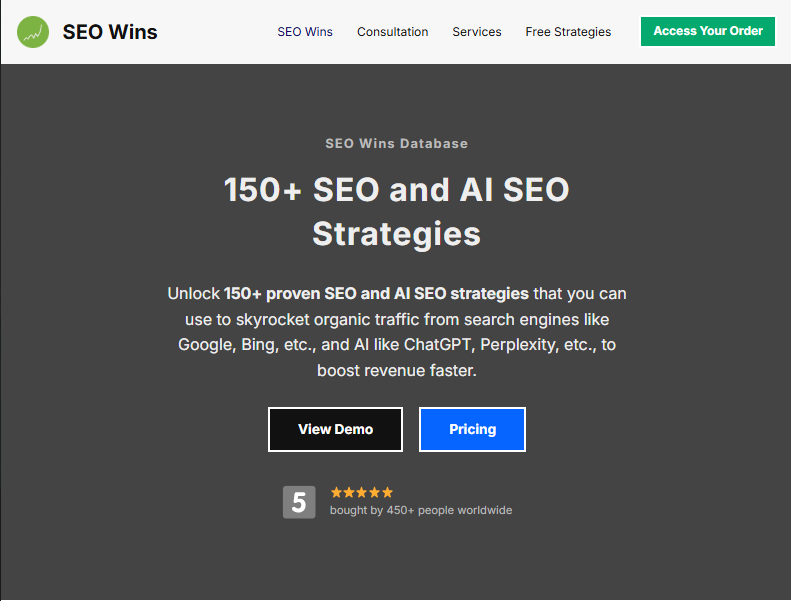
SEO Wins – 150+ SEO and AI SEO Strategies For Growth
$79.00 Original price was: $79.00.$29.00Current price is: $29.00.
- 24/7 Contact Support & Telegram - Ecomkevin_1
- You Can Request Any Courses
- Original Courses HD Qualite and links updated
Guaranteed Safe Checkout


Description
SEO Wins – 150+ SEO and AI SEO Strategies For Growth: A Complete Guide for Modern Marketers
In today’s digital world, businesses no longer grow through guesswork. They grow through data, strategy, and consistency. Search engine optimization has moved far beyond adding keywords to a page. Modern SEO combines human-driven content, technical precision, and increasingly, artificial intelligence. Brands that understand this combination win faster, stay visible longer, and attract customers more organically.
This guide explores how businesses can unlock real growth using more than 150 battle-tested ideas, approaches, and frameworks. Instead of overwhelming you with a list, this article breaks the entire process into practical sections that anyone—from beginner to expert—can follow.
1. Understanding the New SEO Landscape
Search engines have become smarter, and user expectations have evolved. Ranking is no longer about stuffing keywords or building random backlinks. Search engines evaluate intent, relevance, expertise, and user satisfaction. AI models now assess content structure, depth, and originality. This means that every piece of content must genuinely help the reader.
What makes SEO challenging today is also what makes it exciting—there are more tools, insights, and creative opportunities than ever before. With AI-assisted workflows, marketers can optimize research, improve content quality, and test strategies quickly. However, AI alone cannot produce authority. It’s the combination of human creativity with AI-enhanced efficiency that generates SEO wins.
2. Keyword Discovery With AI-Enhanced Precision
Traditional keyword research focused on monthly search volume and difficulty. Now, smart marketers analyze intent layers, question variations, SERP patterns, and competitive content gaps.
To find high-impact keywords:
a. Study Search Intent Thoroughly
Break queries into informational, commercial, transactional, and navigational.
A single topic often contains multiple opportunities—guides, comparisons, tutorials, pricing pages, checklists, case studies, FAQs, and quick answers.
b. Use AI to Find Semantic Variations
AI tools can reveal hidden opportunities—phrases people use naturally in conversation but not obvious in keyword tools. These secondary keywords strengthen topical depth without stuffing.
c. Cluster Keywords by Topic, Not by Volume
Group 20–40 related keywords under larger themes. This supports long-term topical authority and improves ranking stability.
d. Analyze Weak Points in Competitor Content
Look for outdated information, poor formatting, thin explanations, or low E-E-A-T signals. These are areas where you can outperform easily.
This combination ensures you never chase empty trends, but build durable ranking potential.
3. Content Strategy for Long-Term Authority
Content remains the foundation of SEO. But the quality bar is higher today.
a. Build Topic Hubs and Pillars
Start with a strong, comprehensive main article, then link it with supporting content.
This structure helps search engines understand your expertise across a topic.
b. Write With Human Insight and Real Experience
Google now evaluates experience as much as expertise. Add examples, failures, insights, or results from real-world use.
c. Format for Scannability
Use short paragraphs, subheadings, bullet points, visuals, and examples.
Readers stay longer when content is easy to digest.
d. Integrate Unique Data Points
Surveys, case studies, screenshots, graphs, or real conversations add credibility and uniqueness.
e. Use AI as an Assistant, Not an Author
AI can help brainstorm ideas, outline content, and analyze ranking pages, but human refinement ensures authenticity and depth.
4. Technical SEO That Builds a Strong Foundation
Many websites fail not because of content, but because of technical weaknesses.
a. Improve Website Speed
Compress images, use next-gen formats, reduce heavy scripts, and enable caching.
Users leave slow websites instantly.
b. Maintain Clean URL Structures
Short, simple URLs with clear focus help both users and crawlers.
c. Strengthen Internal Linking
Smart internal linking helps distribute authority, improve crawlability, and keep readers exploring deeper into your site.
d. Boost Indexation Quality
Instead of forcing everything into Google’s index, allow only high-quality pages.
Remove duplicates, thin content, and outdated posts.
e. Implement Schema Markup
Rich snippets improve click-through rates and clarity. Use structured data for FAQs, reviews, products, articles, events, videos, and more.
f. Mobile-First Optimization
Most searches happen on mobile, so ensure visuals, text spacing, and loading speed are optimized for smaller screens.
5. AI-Driven Strategies for Smarter Optimization
AI isn’t replacing SEO—it’s enhancing it.
a. Predict SERP Behavior
AI tools can analyze search trends, seasonal patterns, and keyword fluctuations to guide your content plan.
b. Identify Content Gaps Automatically
Machine-learning systems can compare your site to competitors and highlight missing topics or subtopics.
c. Automated On-Page Recommendations
AI can suggest meta tags, headings, semantic improvements, and internal links.
d. Content Refresh Automation
AI can detect declining pages and recommend updates based on current SERPs.
e. Voice Search Optimization
AI-generated voice queries help tailor pages for conversational search.
f. Hyper-Personalized Content
Dynamic content sections can adapt to user behavior—location, preferences, browsing history—improving engagement and conversions.
6. Link-Building that Actually Works in 2025
Backlinks are still a key ranking factor, but quality beats quantity.
a. Create Link-Attracting Assets
Infographics, statistics, calculators, templates, and research pages attract natural links.
b. Build Relationships, Not Just Links
Collaborate with creators, bloggers, podcasters, and subject experts.
These relationships lead to organic mentions over time.
c. Leverage Digital PR
Trends, data releases, and expert commentary often get picked up by publishers.
d. Update Existing Content on Other Sites
Many bloggers welcome help updating outdated posts.
In exchange, they credit your site.
e. Do Guest Features Slowly and Selectively
Focus on high-quality sites relevant to your niche rather than mass submissions.
7. AI + Human Workflow for Maximum Output
The best SEO teams blend automation with creativity.
Here’s a winning workflow:
-
AI identifies topics, clusters, and SERP gaps.
-
Human reviews, organizes, and selects the best ideas.
-
AI drafts outlines and structure.
-
Human writes insights, stories, and final content.
-
AI optimizes technical elements (schema, meta tags, headings).
-
Human performs quality control.
This hybrid system significantly increases content output without losing originality.
8. Conversion Optimization: Turning Traffic Into Sales
SEO without conversions is wasted effort.
a. Clear Calls to Action
Guide users toward subscriptions, purchases, or inquiries.
b. Fast & Optimized Landing Pages
A slow or confusing page instantly kills conversions.
c. Trust Elements
Testimonials, case studies, and social proof build confidence.
d. Interactive Tools
Quizzes, calculators, and dynamic tools engage users and increase time on page.
9. Tracking, Analytics & Continuous Improvement
Successful SEO requires measurement.
a. Monitor Core Web Vitals
Loading speed, stability, and interactivity directly impact ranking.
b. Use Heatmaps
Understand how users interact with pages.
c. Track Keyword Movements
Measure progress weekly, not daily.
d. Analyze Content Decay
Refresh declining pages every few months.
e. Set Revenue-Based KPIs
Beyond traffic, track leads, sales, ROI, and customer lifetime value.
10. Building a Sustainable, Future-Proof SEO System
To stay ahead:
-
Keep updating content regularly
-
Focus on user needs, not algorithms
-
Diversify content types—blogs, videos, tools, guides
-
Maintain clean site architecture
-
Combine AI efficiency with human depth
-
Build a long-term publishing calendar
-
Track performance and iterate endlessly
SEO is a long game, but when done correctly, it becomes the most powerful growth engine a business can have.
Reviews
There are no reviews yet.