
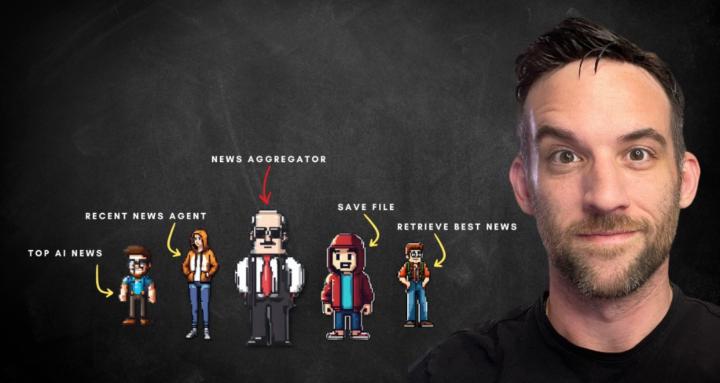
Tyler Reed – The AI Agent
$37.00 Original price was: $37.00.$15.00Current price is: $15.00.
- 24/7 Contact Support & Telegram - Ecomkevin_1
- You Can Request Any Courses
- Original Courses HD Qualite and links updated
Guaranteed Safe Checkout


Description
Tyler Reed – The AI Agent
Introduction
Artificial intelligence has moved far beyond simple chatbots and rule-based automation. Today, we are witnessing the rise of intelligent systems that can reason, execute tasks autonomously, integrate with tools, and continuously improve. At the center of this transformation stands Tyler Reed – The AI Agent, a concept that represents how AI agents are reshaping digital work, online businesses, and productivity at scale.
This guide explores the AI agent model in depth—how it works, why it matters, who it’s for, and how it differs from traditional AI tools. If you are a marketer, entrepreneur, developer, or business owner looking to understand where AI is truly heading, this article will give you a complete and practical understanding.
What Is an AI Agent?
An AI agent is an autonomous system designed to perform tasks, make decisions, and interact with digital environments without constant human input. Unlike standard AI tools that respond only when prompted, AI agents operate with goals, memory, and execution capability.
Key characteristics of AI agents include:
-
Goal-oriented behavior
-
Tool usage and integration
-
Decision-making logic
-
Continuous feedback loops
-
Ability to execute multi-step tasks
This shift transforms AI from being reactive into becoming proactive.
Who Is Tyler Reed?
Tyler Reed is recognized for popularizing and structuring the AI agent ecosystem in a way that makes it accessible to non-technical users. His approach focuses on combining artificial intelligence with automation frameworks so individuals and businesses can deploy intelligent agents that actually perform work—rather than just generate text.
Instead of emphasizing theory, the methodology revolves around real-world execution, scalable workflows, and income-producing use cases.
The Core Philosophy Behind The AI Agent Model
The foundation of this AI agent framework is built on three principles:
1. Autonomy Over Assistance
Traditional AI tools assist users. AI agents replace repetitive human actions by acting independently once configured.
2. Systems Over Prompts
Instead of relying on clever prompts, AI agents rely on structured systems—logic trees, triggers, APIs, and workflows.
3. Scalability Over Effort
One properly designed agent can perform the work of multiple human roles, 24/7, without fatigue.
How AI Agents Actually Work (Step-by-Step)
Understanding the internal workflow of an AI agent clarifies why it is so powerful.
Input Layer
The agent receives data from:
-
User instructions
-
APIs
-
Websites
-
Databases
-
Emails or CRMs
Reasoning Layer
This is where the intelligence lives. The agent:
-
Interprets goals
-
Breaks tasks into steps
-
Chooses tools to use
-
Evaluates outcomes
Action Layer
The agent executes actions such as:
-
Sending emails
-
Publishing content
-
Scraping data
-
Updating spreadsheets
-
Managing ads
-
Responding to customers
Memory Layer
Agents can store:
-
Past actions
-
User preferences
-
Results
-
Contextual information
This allows long-term improvement and smarter decisions.
Real-World Use Cases of AI Agents
AI agents are not theoretical—they are already being deployed across industries.
Digital Marketing
-
SEO content generation and publishing
-
Ad copy testing and optimization
-
Social media scheduling and replies
E-Commerce
-
Product listing creation
-
Inventory monitoring
-
Customer support automation
Business Operations
-
Lead qualification
-
CRM updates
-
Report generation
-
Email follow-ups
Freelancing & Agencies
-
Client onboarding
-
Proposal writing
-
Task management
-
Workflow automation
Why AI Agents Are Replacing Traditional Automation
Old automation tools follow fixed rules. AI agents adapt.
| Traditional Automation | AI Agents |
|---|---|
| Rule-based | Decision-based |
| Breaks easily | Self-correcting |
| No memory | Contextual memory |
| Limited tasks | Multi-step workflows |
This evolution explains why businesses are shifting from tools to agents.
Skills You Don’t Need (And Why That Matters)
One of the most important aspects of this AI agent ecosystem is accessibility.
You do not need:
-
Coding skills
-
Machine learning knowledge
-
Advanced technical background
Instead, users focus on:
-
Defining goals
-
Structuring workflows
-
Monitoring outcomes
This democratization of AI is what makes the model so disruptive.
Monetization Opportunities With AI Agents
AI agents are not just productivity tools—they are income-generating assets.
Service-Based Income
-
AI automation services for businesses
-
Managed AI agents for clients
Productized Solutions
-
Niche-specific AI agents
-
Subscription-based automation tools
Internal Cost Reduction
-
Replacing virtual assistants
-
Scaling operations without hiring
Long-Term Impact on the Job Market
AI agents will not eliminate work—they will eliminate inefficiency.
Roles evolving fastest:
-
Virtual assistants
-
Entry-level marketers
-
Data operators
-
Customer support reps
Roles benefiting the most:
-
Strategists
-
Business owners
-
System designers
-
AI operators
Understanding AI agents early provides a massive competitive advantage.
Ethical and Practical Considerations
Responsible AI agent deployment includes:
-
Transparency with users
-
Data privacy compliance
-
Human oversight for critical decisions
AI agents should enhance human capability, not operate blindly.
Why This AI Agent Framework Stands Out
What differentiates this approach is its focus on:
-
Execution, not hype
-
Real workflows, not demos
-
Business outcomes, not experiments
It bridges the gap between AI potential and actual results.
Final Thoughts
AI agents represent the most significant shift in digital work since the internet itself. They are not tools you use occasionally—they are systems that work continuously on your behalf. Understanding and adopting this model early positions individuals and businesses far ahead of the curve.
Those who learn to design, deploy, and manage AI agents today will define the digital economy of tomorrow.
Reviews
There are no reviews yet.