
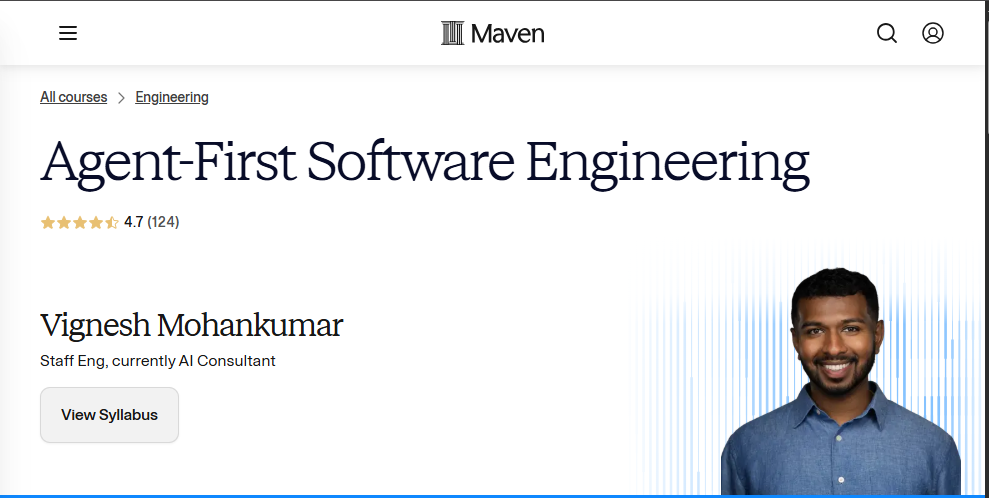
Vignesh Mohankumar – Agent-First Software Engineering
$499.00 Original price was: $499.00.$60.00Current price is: $60.00.
- 24/7 Contact Support & Telegram - Ecomkevin_1
- You Can Request Any Courses
- Original Courses HD Qualite and links updated
Guaranteed Safe Checkout


Description
Vignesh Mohankumar – Agent-First Software Engineering
The software development landscape is evolving faster than ever before. With the rise of large language models, autonomous agents, and AI-assisted coding environments, traditional development workflows are being redefined. At the forefront of this transformation stands Vignesh Mohankumar – Agent-First Software Engineering, a modern framework that reimagines how engineers design, build, test, and scale applications in the AI era.
This approach does not merely integrate AI tools into existing workflows. Instead, it places intelligent agents at the center of the development lifecycle—making them collaborators, orchestrators, and accelerators of productivity.
In this comprehensive guide, we will explore the philosophy, architecture, tools, workflows, and real-world applications of this cutting-edge methodology.
The Evolution of Software Engineering
For decades, software engineering followed a predictable path:
-
Requirement gathering
-
System design
-
Manual coding
-
Testing
-
Deployment
-
Maintenance
Developers wrote every line of logic manually. Even with frameworks, libraries, and automation pipelines, the human developer remained the sole creator of code.
Then came AI-assisted coding tools. Developers could generate snippets, refactor functions, or document code automatically. But this was only the beginning.
Agent-first development shifts the paradigm entirely. Instead of asking, “How can AI assist the developer?” it asks:
“How can intelligent agents take ownership of development tasks under human supervision?”
This shift is what defines Vignesh Mohankumar’s methodology.
What Is Agent-First Software Engineering?
Agent-first engineering treats AI agents as active participants in the software lifecycle rather than passive assistants. These agents are capable of:
-
Understanding high-level requirements
-
Breaking tasks into subtasks
-
Writing production-ready code
-
Running tests
-
Debugging issues
-
Optimizing performance
-
Updating documentation
The human engineer becomes a supervisor, architect, and strategist rather than a line-by-line coder.
This approach dramatically increases output while reducing repetitive tasks.
Core Principles Behind the Framework
1. Agents as Autonomous Contributors
Agents are not limited to generating single responses. They maintain memory, context, and task awareness. This allows them to work across entire repositories, manage dependencies, and iterate on improvements.
2. Human-in-the-Loop Governance
Autonomy does not mean lack of control. Developers define constraints, guardrails, and approval checkpoints to ensure quality and safety.
3. Task Decomposition
Large projects are broken into smaller executable units. Agents handle each module independently before integration.
4. Continuous Learning Feedback
Agents improve based on feedback loops—learning from bugs, failed tests, and performance metrics.
How This Approach Changes the Developer Role
Traditional Developer Role:
-
Writing logic
-
Fixing syntax errors
-
Managing repetitive updates
-
Creating boilerplate code
Agent-First Developer Role:
-
Designing system architecture
-
Defining high-level requirements
-
Reviewing generated code
-
Setting evaluation criteria
-
Managing deployment strategy
Instead of spending hours writing CRUD operations, developers focus on system intelligence and scalability.
Architecture of an Agent-First Workflow
An effective implementation typically includes:
1. Requirement Interpreter Agent
Converts plain-language objectives into technical specifications.
2. Planning Agent
Breaks the specification into structured subtasks and development milestones.
3. Coding Agent
Generates modular code aligned with architecture constraints.
4. Testing Agent
Creates and executes test cases automatically.
5. Debugging Agent
Identifies runtime or logic errors and proposes fixes.
6. Optimization Agent
Improves performance, scalability, and efficiency.
Each agent collaborates within a coordinated system rather than acting in isolation.
Benefits of Agent-First Engineering
🚀 Massive Productivity Boost
Developers can ship products faster than ever before.
💰 Reduced Development Costs
Fewer engineering hours are needed for repetitive tasks.
🧠 Smarter Code Quality
Automated testing and optimization reduce human oversight errors.
🔄 Faster Iteration Cycles
Rapid prototyping becomes realistic and scalable.
📈 Competitive Advantage
Companies leveraging this model gain significant speed and innovation advantages.
Real-World Use Cases
1. SaaS Product Development
Startups can build MVPs within weeks rather than months.
2. Enterprise Automation
Large organizations can modernize legacy systems using AI agents.
3. API Integrations
Agents can automatically connect multiple third-party systems.
4. DevOps Automation
Infrastructure provisioning, CI/CD configuration, and deployment scripts can be agent-managed.
5. Data Engineering Pipelines
Agents design ETL processes and monitor data quality.
Tooling Ecosystem Supporting the Model
An agent-first environment typically integrates:
-
Large Language Models (LLMs)
-
Memory databases
-
Vector search systems
-
Code execution sandboxes
-
Version control systems
-
CI/CD pipelines
These tools combine to create a semi-autonomous development infrastructure.
Step-by-Step Implementation Guide
Step 1: Define Clear Objectives
Write product requirements in structured natural language.
Step 2: Establish Guardrails
Set coding standards, performance benchmarks, and security constraints.
Step 3: Assign Modular Tasks
Break the project into components like authentication, database schema, UI, and API.
Step 4: Deploy Agents Iteratively
Allow agents to generate code for each module and test it automatically.
Step 5: Review & Refine
Human developers validate architecture alignment and approve production readiness.
Step 6: Monitor & Improve
Continuously optimize using analytics and performance insights.
Challenges and Considerations
While powerful, this approach requires strategic implementation.
1. Over-Reliance Risk
Blindly trusting AI without review can introduce hidden bugs.
2. Security Vulnerabilities
Generated code must be audited for injection flaws or insecure patterns.
3. Context Limitations
Agents require well-structured prompts and system context.
4. Organizational Shift
Teams must adapt culturally to working alongside autonomous systems.
Proper governance ensures these challenges are manageable.
The Future of Software Engineering
The trajectory of software development is clear:
-
AI-native architectures
-
Autonomous development cycles
-
Self-healing systems
-
Continuous intelligent optimization
Agent-first engineering is not a trend—it is an evolution.
Developers who embrace this methodology today position themselves at the forefront of technological transformation.
Why This Framework Matters Now
The global demand for software engineers is growing rapidly. At the same time, complexity is increasing. Companies need faster delivery, stronger reliability, and scalable systems.
Traditional workflows cannot keep pace indefinitely.
The philosophy behind Vignesh Mohankumar – Agent-First Software Engineering addresses this gap by enabling:
-
Scalable innovation
-
Reduced burnout
-
Higher-quality codebases
-
Intelligent collaboration between humans and AI
This model empowers developers rather than replacing them.
Who Should Learn This Approach?
-
Software Engineers
-
Tech Founders
-
CTOs
-
AI Enthusiasts
-
DevOps Engineers
-
Product Managers
Anyone involved in building digital products can benefit from understanding this paradigm.
Practical Example Scenario
Imagine building a task management SaaS application.
Traditional approach:
-
Weeks writing backend logic
-
Manual database setup
-
Repetitive frontend scaffolding
-
Writing unit tests
Agent-first approach:
-
Define system requirements
-
Agent generates backend API
-
Another agent sets up database schema
-
Testing agent creates coverage suite
-
Optimization agent improves performance
Development time is reduced dramatically.
Performance Metrics to Track
When implementing agent-first systems, measure:
-
Development velocity
-
Bug reduction rate
-
Code review time
-
Deployment frequency
-
System reliability
These KPIs reveal measurable productivity improvements.
Final Thoughts
The shift toward intelligent, agent-driven workflows represents one of the most significant changes in software engineering history.
By placing AI agents at the center of the development lifecycle, engineers unlock unprecedented efficiency and innovation potential.
Vignesh Mohankumar – Agent-First Software Engineering is more than a concept—it is a blueprint for the next generation of builders who want to create smarter systems, faster, and with greater impact.
Those who adapt early will define the future of technology.
Reviews
There are no reviews yet.